VDA 19.1 to IEST-STD-CC1246: Complete Guide for Aligning Automotive to Aerospace Technical Cleanliness
Introduction: The Need for Cross-Industry Technical Cleanliness Alignment
As more precision component manufacturers expand production boundaries from automotive manufacturing to high-end aerospace applications, technical cleanliness standard alignment has become a core compliance and quality challenge. The automotive industry universally adopts VDA 19.1 (harmonized with ISO 16232) to regulate component cleanliness, focusing solely on particulate contamination for powertrain systems, hydraulic assemblies, and EV component cleanliness control. In sharp contrast, the aerospace sector adheres to the rigorous IEST-STD-CC1246E standard, the upgraded iteration of the traditional MIL-STD-1246, which defines full-range precision component cleanliness criteria for mission-critical aviation, aerospace, and satellite components.
A prevalent industry pain point is that conventional automotive technical cleanliness workflows cannot fully meet aerospace contamination control requirements. Fundamental discrepancies in benchmark units, particle measurement algorithms, and mandatory testing scopes create compliance gaps. This article provides a practical, production-verified framework for VDA 19.1 vs IEST-STD-CC1246 conversion, enabling manufacturers to upgrade automotive-grade cleanliness processes efficiently, satisfy strict aerospace precision cleanliness specifications, and achieve complete cross-standard technical cleanliness compliance.

Core Differences Between VDA 19.1 and IEST-STD-CC1246E Cleanliness Standards
To successfully align automotive cleanliness systems with aerospace protocols, manufacturers must first clarify the fundamental gaps between the two standards in contamination control, benchmarking, and evaluation rules.
1. Standard Scope & Contamination Control Range

VDA 19.1 is the foundational automotive technical cleanliness standard dedicated exclusively to solid particulate contamination assessment. It utilizes dual verification methods: gravimetric particle weight test and optical particle counting to quantify solid debris, including metallic particles, non-metallic debris, and surface fiber contamination. Widely deployed in automotive mass production, it governs EV component cleanliness, fuel injector cleanliness testing, transmission part contamination inspection, and automotive hydraulic component cleanliness validation, focusing on eliminating hard particle-induced mechanical failures.
IEST-STD-CC1246E, the authoritative aerospace precision cleanliness specification, implements dual-layer contamination control covering solid particulate contamination and harmful molecular contamination. Beyond conventional particle counting, it enforces mandatory Non-Volatile Residue (NVR) testing and ionic residue detection to eliminate invisible organic residuals, solvent contaminants, and micro molecular pollutants. This comprehensive NVR contamination control aerospace mechanism is critical to preventing seal swelling, circuit failure, and performance degradation of high-value aerospace hydraulic valves, satellite components, and aircraft fuel system parts.
2. Benchmark Area & Measurement Logic
The biggest technical barrier for cross-standard cleanliness migration lies in inconsistent benchmark dimensions and particle measurement definitions. VDA 19.1 normalizes all industrial part cleanliness test data based on per cm² component surface area. It adopts fixed particle size bins (1μm, 5μm, 15μm, 30μm, 50μm, 100μm) and classifies product quality via standardized VDA cleanliness classes (K0, K0.3, K1, K3, K4), forming a fixed grading system for automotive component inspection.
In contrast, IEST-STD-CC1246E unifies all aerospace cleanliness testing under a fixed 0.1 ft² (92.903 cm²) benchmark area. It applies a logarithmic normal distribution model to calculate particle limits, featuring continuousIEST cleanliness levels (L10, L25, L50, L100) instead of rigid fixed grading intervals. Another key technical deviation lies in particle dimensional measurement: VDA 19.1 adopts maximum Feret diameter, while IEST standards apply equivalent spherical diameter, resulting in a 5%–15% inherent data deviation that requires professional calibration for accurate particle size distribution testing.
3. Compliance Judgment Rules
VDA 19.1 adopts a single-dimensional compliance judgment: excessive total particle weight or oversized killer metal particles will render components non-compliant. However, IEST-STD-CC1246E enforces strict dual-qualification rules for aerospace precision cleanliness: both qualified particle size distribution and compliant NVR contamination results are mandatory for pass certification. This dual-control mechanism makes aerospace cleanliness requirements far more rigorous than conventional automotive technical cleanliness standards.
Practical VDA 19.1 to IEST-STD-CC1246 Conversion Methodology
For manufacturers transitioning from automotive to aerospace precision manufacturing, accurate data conversion and grade matching are the core of reliableautomotive to aerospace cleanliness standard mapping. Below is a fully verified, industry-approved conversion workflow to realize standardized cross-standard technical cleanliness compliance in mass production and laboratory testing.
1. Benchmark Area Normalization
All VDA 19.1 test data calculated based on cm² surface area must be normalized to the IEST unified 0.1 ft² benchmark to eliminate unit mismatch errors, the most common flaw in cross-standard cleanliness validation. The fixed conversion factor is 92.903, with a universal formula: IEST particle count per 0.1ft² = VDA particle count per cm² × 92.903. Accurate area normalization ensures consistent data comparability for all precision component cleanliness inspections.
2. Particle Size Interval Mapping
To bridge fixed VDA particle bins and IEST’s continuous logarithmic calculation logic, the industry adopts unified comparison particle diameters: 1μm, 5μm, 15μm, 30μm, 50μm, and 100μm. This unified dimension standard ensures consistent statistical caliber for particle size distribution testing, enabling seamless data comparison between automotive VDA 19.1 testing systems and aerospace IEST-STD-CC1246E inspection protocols.
3. Industry-Recognized Grade Correspondence (Engineering Reference)
Since there is no official one-to-one equivalent between VDA and IEST cleanliness grading systems, the following empirical grade mapping is widely adopted for internal quality control, process debugging, and aerospace project pre-validation:
IEST L10 (satellite & ultra-precision aerospace parts) ≈ VDA K0.3 (highest automotive cleanliness class)
IEST L25 (aerospace hydraulic valve) ≈ VDA K1
IEST L50 (general aviation structural parts) ≈ VDA K3
IEST L100 (ordinary mechanical components) ≈ VDA K4
Note: This mapping is for internal reference only. Official aerospace drawings require dual-standard specification rather than single-grade replacement.
Fill the Gap: Add Mandatory IEST NVR Contamination Control Items
The biggest limitation of traditional VDA 19.1-based automotive cleanliness systems is the absence of NVR Non-Volatile Residue and molecular contamination management, which serves as the core audit indicator of IEST-STD-CC1246E aerospace precision cleaning. To achieve full aerospace compliance, manufacturers must upgrade existing testing systems and production processes to cover molecular contamination control and complete full-spectrum technical cleanliness governance.
1. NVR Testing Specifications for Aerospace Cleanliness
NVR contamination control aerospace requires standardized solvent extraction (using high-purity isopropanol or acetone), constant low-temperature drying, and high-precision gravimetric weighing to quantify organic residue content per 0.1ft² benchmark area. Classic aerospace grade thresholds include ≤25μg/0.1ft² for IEST L10 ultra-precision satellite components and ≤100μg/0.1ft² for IEST L25 aerospace hydraulic components. Residual cutting fluid, lubricating grease, and anti-rust oil from conventional automotive processes are the primary causes of NVR non-compliance, easily triggering aerospace seal swelling, circuit leakage, optical lens fogging, and other fatal component failures.
2. Enhanced Particle Morphology & Material Identification
Unlike VDA 19.1’s simple binary metal/non-metal classification, IEST-STD-CC1246E mandates refined contamination identification and grading for metallic particles, soft debris, fiber contamination, and silica dust. It imposes strict restrictions on killer metal particles—high-hardness steel and titanium debris—with most aerospace parts prohibiting metallic particles larger than 80μm. Laboratories must upgrade inspection equipment with EDX particle material identification and long fiber judgment algorithms to meet rigorous aerospace precision component cleanliness standards.
Process & Laboratory Upgrades for Dual-Standard Compliance
To support dual-standard compliance for both automotive technical cleanliness (VDA 19.1) and aerospace precision cleanliness (IEST-STD-CC1246E), manufacturers need targeted upgrades to production workflows, cleanliness extraction procedure, laboratory cleanroom environment, and quality management systems.
1. Unified Cleanliness Extraction Procedure
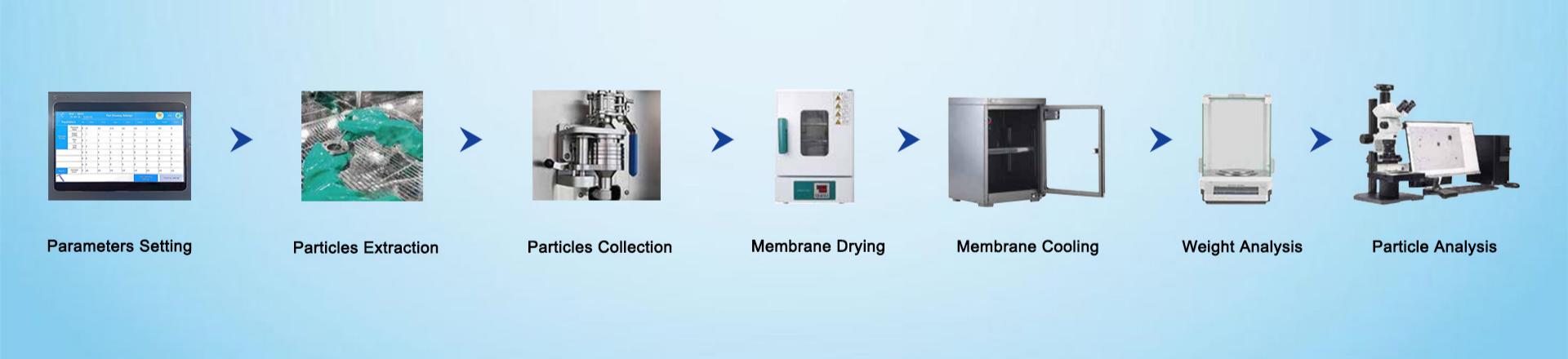
Traditional automotive cleanliness processes rely on water-based cleaning and simple flush extraction, which cannot eliminate molecular residues required by aerospace standards. The optimized dual-standard compatible process is: water-based rough cleaning to remove large cutting debris → ultrasonic fine cleaning with high-purity solvent → vacuum low-temperature drying to completely eliminate NVR residue. All tests adopt unified 0.45μm mixed cellulose filter membranes for standardized filter membrane particle analysis, satisfying the testing requirements of both VDA 19.1 and IEST-STD-CC1246E.
2. Cleanroom & Test Environment Upgrade
Standard automotive technical cleanliness laboratories typically comply with ISO 14644 Class 7 cleanroom standards, while aerospace IEST testing requires an upgraded Class 6 cleanroom environment to reduce background interference. Meanwhile, blank test validation thresholds are tightened from the conventional 10% to 5% of the standard limit, effectively eliminating environmental contamination interference and ensuring high accuracy of aerospace cleanliness test data.
3. AS9100 Quality System Matching
Aerospace contamination control requires full-process traceability compliant with AS9100 quality systems. Manufacturers need to standardize dust-free tooling, anti-contamination packaging, and operator clean operation specifications, shorten equipment calibration cycles, and establish SPC real-time monitoring for particle counting and NVR testing. This systematic management effectively avoids contamination-induced valve sticking, component abrasion, and premature product failure in mission-critical aerospace equipment.
Standardized Drawing & Report Specification for Cross-Standard Delivery
To eliminate technical disputes in aerospace customer audits, all component drawings and test reports must adopt dual-standard standardized expression, avoiding single VDA 19.1 marking.
Standard Drawing Marking Template: The component surface industrial part cleanliness complies with VDA 19.1 particulate counting specifications; after professional surface area normalization, it meets the particle distribution limits of specified IEST-STD-CC1246 Level, with NVR non-volatile residue and ionic residue fully compliant with corresponding aerospace grade requirements, and the maximum size of hard metallic killer particles strictly controlled within the specified range.
Dual-Standard Test Report: Output VDA 19.1 data (total surface area, particle grading quantity, total impurity weight) and converted IEST data (0.1ft² benchmark particle quantity, NVR residual value, aerospace level conformity judgment) simultaneously to support customer compliance review.
Common Pitfalls in VDA-to-IEST Cleanliness Alignment
Blind grade equivalence: VDA K classes and IEST L levels are for reference only, cannot replace formal specification marking, and dual-standard constraints are mandatory for aerospace parts.
Ignoring NVR testing: Molecular contamination inspection is the primary audit item of IEST-STD-CC1246; pure particulate testing per VDA 19.1 will directly lead to audit failure.
Incorrect unit conversion: Reversed cm² and 0.1ft² conversion factors cause loose internal control standards and batch component failure risks.
Uncorrected particle deviation: Feret diameter data without spherical diameter correction will cause inconsistent particle grading results.
Conclusion
Upgrading from automotive technical cleanliness (VDA 19.1) to professional aerospace precision cleanliness (IEST-STD-CC1246E) is not a simple standard replacement, but a systematic quality upgrade covering particle counting calibration, molecular contamination control, precision cleaning process optimization, and standardized quality delivery. By mastering accurate cross-standard area conversion, completing NVR testing system supplementation, optimizing dual-standard cleanliness extraction procedure, and unifying report and drawing specifications, manufacturers can steadily achieve cross-standard technical cleanliness compliance and meet the ultra-high requirements of aerospace hydraulic assemblies, satellite precision components, and aviation mission-critical parts.
CTA
Need a customizable VDA 19.1 to IEST-STD-CC1246 cleanliness conversion sheet and aerospace-compliant technical cleanliness drawing template? Contact our professional technical cleanliness laboratory team to obtain one-stop cross-standard compliance guidance and professional precision cleaning validation solutions for automotive-to-aerospace component upgrading.