With the widespread adoption of the concept of short-distance green travel, the market penetration rate of electric two-wheelers has continued to rise, and the scale of the cycling population has also been expanding. From ordinary commuters and delivery riders for daily commutes, to various users who enjoy leisure cycling and climbing slopes, the cycling scenarios have become increasingly diverse, and the demands of users have also become more specialized.
Whether it is commuting users or customers with different needs, their core requirements for electric two-wheelers will also vary. Some prioritize energy efficiency, some value continuous torque and load capacity, and there are users who expect intelligent adjustable and multi-mode switching power experiences. This also means that a single traditional controller is no longer able to meet the cycling experiences of different users.

1. Commuter Users: Range and Smoothness
For commuters who travel about 10-15 kilometers per day, these users are extremely sensitive to range. The electronic control system must have high-precision current sampling and estimation algorithms to avoid mileage misreporting. During frequent start-stop conditions, the torque output must be linear and smooth, eliminating start-up jolts, while also suppressing electromagnetic noise to ensure quiet riding.
2. Delivery Riders: Heat Resistance and High Load Capacity
Delivery workers and courier professionals have specific demands for the electronic control system, focusing on high load tolerance and thermal stability. This group travels extremely long distances daily and constantly faces high-load climbing, sudden acceleration, and frequent braking in high-intensity conditions. The electronic control system must have stable operation capabilities across a wide temperature range. The design of power components and heat dissipation structures must ensure that it does not trigger thermal protection and reduction in power output under continuous high-current output, maintaining the continuity and controllability of power output. At the same time, the response speed and recovery efficiency of the regenerative braking system in frequent start-stop scenarios are subject to higher requirements. The electronic control system must achieve coordinated control of mechanical braking and electric braking to ensure the balance between braking safety and energy recovery efficiency.
3.Performance Enthusiasts: Response and Precision
For electric motorcycle users with performance-oriented preferences, the core focus is on the speed of power response and the accuracy of control. They require the electronic control system to have a faster torque response bandwidth, higher current tracking accuracy, and effectively reduce torque pulsation. The controller must support multiple power output modes and traction control, adapting to the power adjustment requirements of different scenarios.
4.Shared Mobility Operators: Durability and Maintenance
Shared mobility operators and fleet managers place more emphasis on the durability and maintainability of the electronic control system. Due to the special nature of vehicle operation, they need to face frequent changes in drivers, with highly variable usage habits, and the electronic control system must have a sound fault diagnosis and protection mechanism, including multiple self-protection functions such as overcurrent, overtemperature, undervoltage, and anti-loss of control. At the same time, it supports remote firmware upgrades and data transmission capabilities, facilitating the maintenance team to carry out predictive maintenance and rapid fault location, reducing vehicle repair rates and maintenance costs.
5.The Underlying Logic of Drive Electronic Control
Although different user groups have varying focuses on drive electronic control, the common underlying logic that runs through all application scenarios is highly consistent - namely, safety, efficiency, and reliability. These three dimensions constitute the underlying logic of drive electronic control products and are also the prerequisite for any differentiated functional innovation.
In terms of safety, the electronic control system must establish a complete system protection mechanism, covering multiple fault detection and handling logic for overvoltage, undervoltage, overcurrent, overtemperature, inter-phase short circuit, and runaway prevention, ensuring that it can actively limit or cut off power output in extreme conditions to avoid vehicle risks.
In terms of efficiency, the electronic control system uses magnetic field orientation control algorithms to keep the motor operating at high efficiency under different speeds; it also supports regenerative braking, converting kinetic energy into electrical energy and charging the battery during coasting or downhill, reducing energy waste. The good performance of the algorithm requires hardware support. The modular controller for brushless motor 48V achieves more efficient energy conversion through precise matching of modular power components and different motors.
In terms of reliability, the electronic control system must undergo environmental tests such as high and low temperature cycles, wet heat, salt spray, and vibration to meet and pass the reliability verification of the product, ensuring that the electronic control system can work stably in different climate conditions for a long time.
6.WISE's Drive Electronic Control Products in Xiamen
WISE's drive electronic control products have fully met the above basic performance requirements and further built differentiated technical advantages.
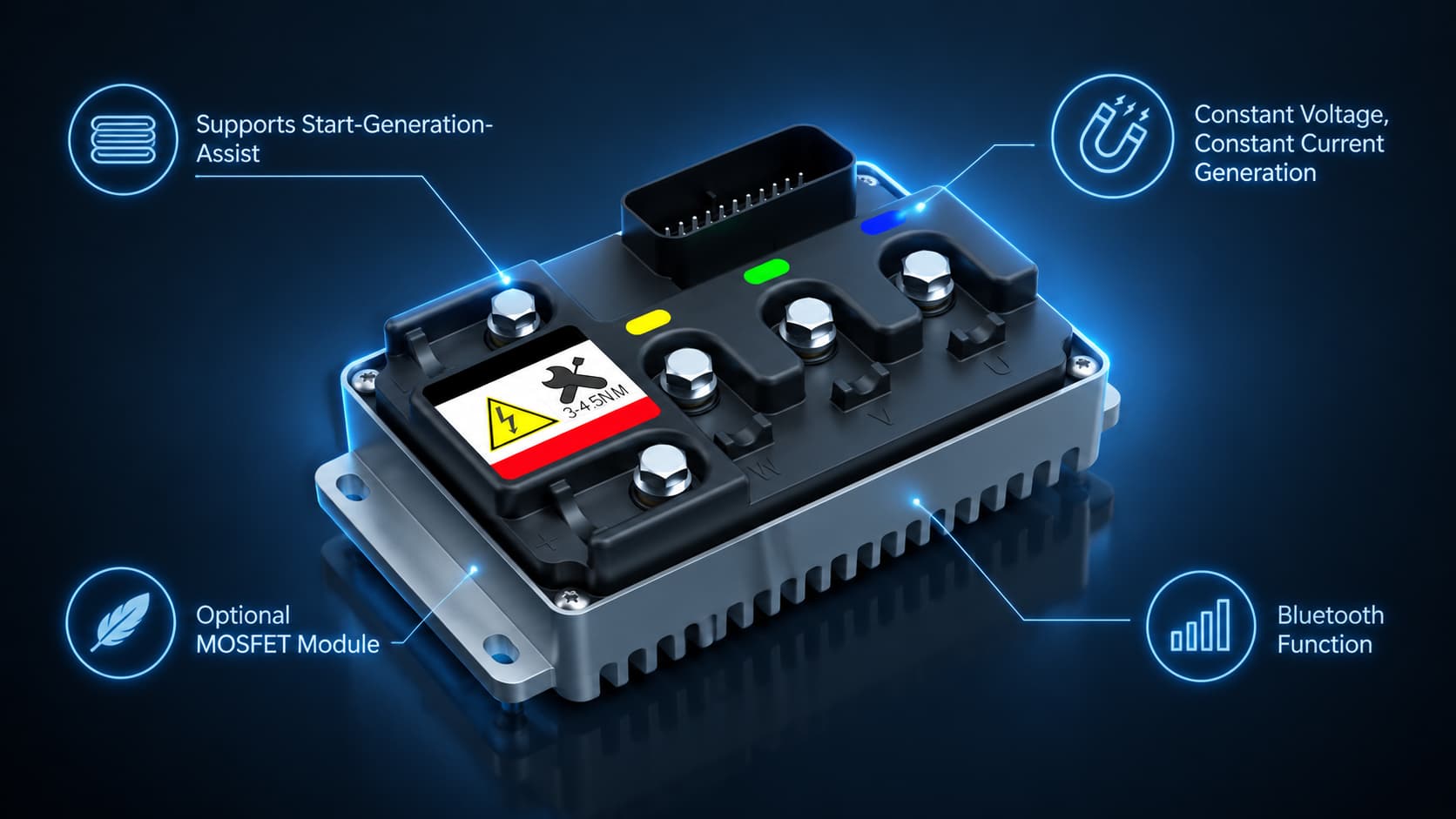
Multifunctional integrated operation mode. The product supports intelligent switching between start-up, power generation, and assistance modes, covering all scenarios. It also provides two control strategies: constant voltage and constant current. This is a smart brushless controller with integrated modes. These three modes are not simply combined but are intelligently decided and seamlessly switched based on the riding conditions, covering all scenarios of power demand for the controller.
It features a configurable modular design. The product offers a modular MOSFET selection scheme, allowing for flexible combination of power devices according to power levels and application scenarios, balancing performance limits and cost control. Additionally, it can be optionally equipped with Bluetooth functionality, enabling wireless data interaction with mobile terminals, supporting intelligent functions such as parameter configuration, operation status monitoring, and remote firmware upgrade. The architecture design of this 48 volt controller with Bluetooth significantly reduces the difficulty for maintenance personnel and shortens the time to solve problems.
Xiamen WISE has always been guided by the actual application needs of users, continuously deepening the fundamental technological innovation and functional expansion in the field of drive electronic control. It is committed to providing the industry with drive electronic control solutions that combine performance, reliability and intelligent level.
If you want to know more about the drive electronic control of electric two-wheelers, you can click on the picture on the left to view the product details or send your requirements to our email: wisedrv@wiseelec.cn.