Quick Answer & Comparison Table
Quick Answer: Photoluminescent (glow-in-the-dark) film is a passive, no-power safety material that stores ambient light and glows in total darkness. It is primarily used for emergency evacuation marking, building safety guidance, industrial hazard labeling, and low-light infrastructure safety for commercial, construction, and industrial projects.
Photoluminescent Film vs Reflective Film vs Electric Signs
|
Item |
Photoluminescent Film |
Reflective Film |
Electric Luminous Signs |
|
Works in total darkness |
✅ Yes |
❌ No |
✅ Yes (needs power) |
|
Power required |
❌ No |
❌ No |
✅ Yes |
|
Installation & Maintenance |
Easy, low maintenance |
Easy |
Complex, high maintenance |
|
Best use case |
Power-failure emergency safety |
Traffic reflection |
Fixed powered signage |
Introduction
Safety visibility during blackouts and low-light conditions is critical for building compliance, job site safety, and industrial facility management. Photoluminescent film is a widely used passive luminous material that requires no electricity, no wiring, and offers long-lasting glow performance. This article covers its main uses, practical project applications, key benefits, and professional selection tips for engineers, contractors, procurement managers, and distributors.
What Is Photoluminescent Film?
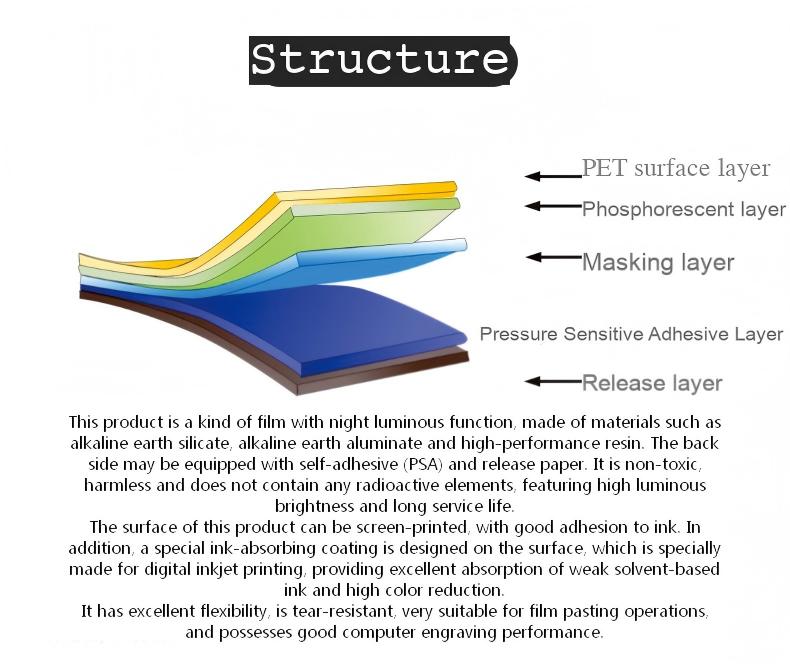
Photoluminescent film absorbs natural or artificial light energy and releases soft light in dark environments. Featuring fire resistance, weather resistance, and zero power consumption, it is a standard safety material for emergency marking. Unlike reflective film, it performs reliably even in complete blackouts.
Main Uses of Photoluminescent Film
- Fire & Emergency Safety: Emergency exit paths, stairwell evacuation marking, fire equipment positioning for offices, malls, schools, and hospitals.
- Building & Construction: Step edge marking, dark corridor guidance, underground passage safety indicators for new builds and renovation projects.
- Industrial & Warehouse Safety: Aisle lines, obstacle marking, low-light workshop safety reminders to reduce onsite accidents.
- Infrastructure & Special Scenarios: Tunnels, subways, ports, and marine cabin evacuation marking for harsh environment safety.
Real Project Case
Commercial Building Fire Safety Upgrade Case
A multi-story commercial building applied industrial-grade photoluminescent film for full-stairwell evacuation routes and emergency exit marking. The solution required no wiring, shortened construction time, and helped the project pass official fire safety inspection successfully. During unexpected power outages, the film provided continuous visible guidance, greatly improving on-site emergency safety while cutting long-term electricity and maintenance costs compared with electric sign systems.
Key Benefits for B2B Users
- For Engineers & Contractors: Easy installation, stable performance, helps project compliance and acceptance.
- For Procurement Managers: Zero energy cost, low maintenance, cost-effective for bulk purchasing.
- For Distributors: Wide industry demand, versatile scenarios, stable-selling safety product.
Buying & Selection Tips
When sourcing photoluminescent film, focus on 3 core indicators: luminous duration (2–12 hours for industrial grade), fire-retardant certification, and weather resistance. Choose indoor-grade films for building interiors and upgraded weatherproof grades for outdoor, tunnel, and marine use. Besides, material selection is key to cost control and practical usage. PET photoluminescent film features a more competitive price, suitable for simple cutting and standard marking applications only. For projects that require pattern or text printing, PVC photoluminescent film is the ideal choice, which perfectly supports printing processing and effectively saves overall procurement and construction costs.
FAQ
Q: Does photoluminescent film work without electricity?
A: Yes. It is fully passive and requires no power supply or wiring.
Q:How long can photoluminescent film glow?
A: Qualified industrial-grade film glows continuously for 2–12 hours after full light absorption.
Q: What’s the difference between photoluminescent and reflective film?
A: Photoluminescent film glows in total darkness for emergency safety; reflective film only bounces external light and fails during blackouts.
Q: Is photoluminescent film fire safe?
A: Certified industrial grades feature fire-retardant, non-toxic, and radiation-free performance for public safety projects.
Core Summary
Photoluminescent film is a cost-effective, zero-power safety material mainly used for emergency evacuation and low-light safety marking in buildings, construction sites, industrial warehouses, and infrastructure projects. It outperforms reflective film and electric signs in blackout scenarios, supports project compliance, and delivers long-term cost savings for B2B engineering and procurement projects.
Conclusion
If you need certified photoluminescent film for engineering projects, bulk distribution, or customized safety marking solutions, contact our team for free samples and professional technical support.