As the process of vehicle electrification continues to accelerate, vehicle OEMs will face many crucial choices when selecting powertrain technology suppliers. Choosing the right technical partner will directly affect product competitiveness, project progress, and the iterative capabilities of the product in the later stages. Therefore, the procurement teams of vehicle manufacturers need to establish a complete evaluation system.
Technical platform capabilities
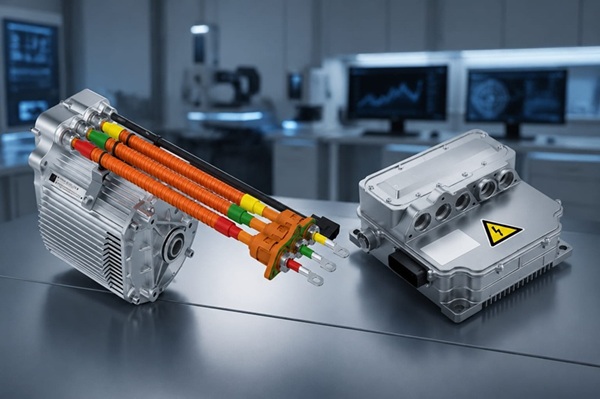
The first step for OEMs when selecting automotive component manufacturers is to assess the product layout matrix of the supplier, which can reflect the product coverage and development strength of the supplier. Mature suppliers will build modular electric drive product platforms, create matrices of electric drive systems with different power and voltage, and adapt to diverse application scenarios.
Here is a reference for our multi-scenario power platform:
| Product Platform Classification | Covered Voltage Range | Typical Application Scenarios | Core Product Composition |
| Micro-Vehicle Powertrain System | 96V / 320V | Low-Speed Micro-Vehicles | Flat-Winding Motor + Controller Complete System |
| Off-Highway & Commercial Vehicle Propulsion Platform | 320V / 540V | Construction Machinery, Commercial Special-Purpose Vehicles | Extended-Range / Pure-Electric Controller, 2-In-1 Generator-Drive Unit |
| Low-Altitude Propulsion Platform | 450-750V | Low-Altitude Aircraft | 2-In-1 Generator-Controller Unit |
| E-2/3-Wheeler & E-Motorcycle Platform | 48-96V | E-Motorcycles, 2-/3-Wheel Mobility Vehicles | Motor Controllers of Various Power Ratings |
| DCDC Converter | 48V to 320V | Vehicle On Board Voltage Conversion | Mountable DCDC Controller |
Based on this, it is necessary to conduct further verification of the R&D technical level. This is crucial for ensuring the rapid adaptation and iterative upgrading of electric drive products and the vehicle project in the future.
Match platform customization development requirements
Automotive manufacturers need to assess the development capabilities of suppliers in adapting to different vehicle platforms. A large number of projects in the industry have a hard requirement for customization development. For OEMs, suppliers that have both the ability to deliver mature standard products and custom motor & control solutions have greater cooperative value.
By adopting the "standard products + on-demand customization" model and coordinating efficiently in engineering, risks in vehicle integration can be avoided in the early stage of the project, and the cost of later modifications can be reduced. This is particularly crucial for special vehicles and medium-low voltage platform projects.
Quality control
Complete factory inspection is the first barrier to assess the reliability of a product. As an OEM, it is necessary to verify the supplier's capabilities. The following three types of tests should be given special attention:
1. Bench testing: Conducting rated / peak condition tests on the entire electric drive system to verify core indicators such as power, torque, system efficiency, temperature rise, NVH (noise, vibration, and harshness) noise and vibration, ensuring that the actual output is consistent with the parameters specified in the specification;
2. Durability and reliability testing: Testing whether it can complete continuous condition durability and alternating load shock tests to verify the stability of the motor and controller during continuous operation, avoiding the risk of fatigue failure;
3. Environmental adaptability testing: Covering high and low temperature cycles, temperature variations, and humid heat environmental tests, simulating extreme usage scenarios such as extreme cold and heat, to confirm that the entire machine can operate stably in different environments.
All tests should retain complete and traceable test reports. Rejecting solutions that rely solely on theoretical simulation without real measurement verification.
Industry and overseas market certifications
The system certifications that the supplier possesses in the industry are also particularly crucial. For electric drive system manufacturers in the automotive component manufacturing industry, the IATF16949 automotive quality management system is the basic entry threshold, representing that the enterprise has standardized automotive component design, manufacturing, and quality control capabilities. For overseas markets, CE certification is an important entry qualification for product exports to regions such as the European Union. OEMs need to combine their target markets to confirm the overseas product qualifications of the suppliers.
Verify the capability for mass production
At present, there is a market pain point in the industry: although the prototype of the product performs well, it cannot smoothly transition to mass production. OEMs should focus on checking whether the suppliers can deliver production-ready electric drive systems. Verify the vehicle-grade verification, complete test reports, and the process control level at the production site to ensure the quality consistency between the prototype and the batch products. At the same time, assess the supplier's existing production capacity and expansion capabilities, as this is related to whether the later equipment for components can keep up with the supply requirements after the vehicle is launched.
Collaborative R&D technical capability
A high-quality and qualified supplier not only needs to deliver hardware prototypes but also needs to deeply participate in the entire vehicle development process. In the early stage of the project, they should cooperate to complete vehicle system simulation and indicator matching, outputing dynamic models that can be used for vehicle simulation; during the development stage, provide bench testing, real vehicle calibration services, and complete torque strategy, braking energy recovery, and thermal protection logic tuning; and simultaneously output complete engineering documents such as CAN matrices, UDS diagnostic specifications, fault libraries, and mechanical and electrical drawings to support vehicle integration, certification, and subsequent after-sales maintenance work.
Weigh the value of long-term partners
When OEM conducts supplier evaluations, they need to comprehensively consider the customized development capabilities, mass production maturity, system performance, and long-term cooperation potential. High-quality suppliers not only need to create a suitable high-performance electric vehicle powertrain, but also need to have the ability to provide technical services throughout the entire vehicle development cycle. Both parties maintain the same technical approach, along with timely and efficient technical support, to jointly promote the iteration and market implementation of the vehicle project.
Our capability assessment is as follows:
| OEM Core Evaluation Items | Our Capability Description |
| Multi-Scenario Product Portfolio | Covers micro-vehicles, off-highway construction machinery, low-altitude aircraft, 2-/3-wheel e-motorcycles and DCDC power supplies |
| Custom Development | Supports joint custom development for motor & controller hardware structure and software strategy |
| Quality Validation | Complete factory validation including bench test, durability test, high-low temperature & humidity test with traceable test reports |
| Certifications | IATF16949, CE certification and multiple patents |
| Mass Production & Delivery | Capable of mass production and capacity expansion |
| R&D Collaboration | CAN/UDS support, calibration & debugging, full-set engineering document delivery and full-lifecycle technical services |
Learn more
If you are looking for a reliable powertrain partner for your entire vehicle project, please click to view the complete electric drive system product catalogue and gain a deep understanding of the detailed technical information of the motor controller platform. If you have requirements for scheme adaptation, sample testing or batch supply, please send your project information to the official email: wisedrv@wiseelec.cn. You can also jump to the contact us page to submit your project information. Our engineering team will provide one-on-one professional technical consultation based on your application scenario.