An Isuzu fuel tanker truck can be configured with different tank capacities depending on the chassis, tank dimensions and intended application. Based on the Isuzu fuel tanker models listed by Powerstar Trucks, available examples range from 4,000 liters to 25,000 liters, with intermediate options including 5,000L, 6,000L, 10,000L and 12,000L.
For example, the Isuzu ELF 100P fuel dispenser truck has a 4,000-liter tank, the Isuzu KV600 carries 6,000 liters, an Isuzu FTR tanker is available with a 12,000-liter tank, and the heavy-duty Isuzu GIGA 6x4 fuel tanker is configured with a 25,000-liter tank.
The actual capacity you need depends on how much fuel you transport, whether the vehicle is used for road delivery or on-site refueling, the number of tank compartments, and the legal weight limits in your country. Below, Powerstar Trucks explains the available capacities, representative vehicle configurations and key considerations when choosing an Isuzu fuel tanker.

What Is the Typical Capacity of an Isuzu Fuel Tanker Truck?
Isuzu fuel tanker trucks are available in different capacities to meet the needs of small businesses, fuel distributors, construction companies, mining operations and large-scale petroleum transportation projects.
Here is a quick overview of the representative tank capacities available from Powerstar Trucks:
| Isuzu Model | Tank Capacity | Typical Application |
|---|---|---|
| ELF 100P | 4,000 L | Small-scale fuel delivery |
| KV100 | 5,000 L | Mobile refueling |
| KV600 | 6,000 L | Fleet and construction refueling |
| FTR | 10,000–12,000 L | Commercial fuel transportation |
| GIGA 6x4 | 25,000 L | Large-scale fuel distribution |
These capacities refer to specific vehicle configurations, not fixed limits for each Isuzu chassis family. Tank capacity can be customized according to the vehicle design, chassis specifications and applicable regulations.
For buyers comparing different configurations, our Isuzu fuel tanker truck product range provides more information about available models and applications.
Isuzu 4,000L Fuel Tanker Truck: A Compact Refueling Solution
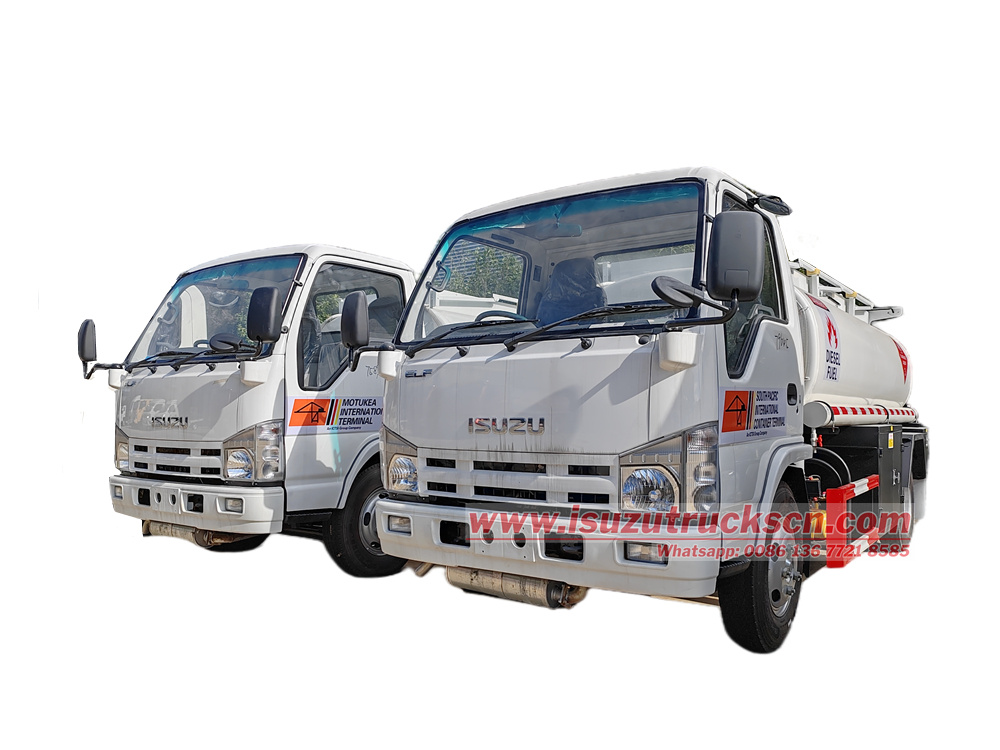
The Isuzu ELF 100P 4,000L fuel tanker is a compact option for businesses that need flexible fuel transportation and on-site refueling. It is built on the Isuzu ELF 100P light-duty chassis and is designed for operations where a large tanker would be less convenient.
One configuration listed by Powerstar Trucks has the following specifications:
• Tank capacity: 4,000 liters
• Chassis: Isuzu ELF 100P
• Engine: Isuzu 4KB1-TCG60
• Engine output: 130 HP
• Wheelbase: 3,360 mm
• Drive configuration: 4x2
• Tank material: Q235B carbon steel
• Fuel pump: 30 m³/h
The vehicle can be equipped with a fuel dispenser, a 15-meter refueling hose reel, a fuel nozzle, a liquid-level display, valves and safety equipment.
A 4,000-liter Isuzu fuel tanker is suitable for smaller construction sites, farms, local distribution routes, workshops and businesses that need to refuel their own equipment.
See the Isuzu ELF 4000L fuel dispenser truck for the detailed product configuration.
Isuzu 5,000L and 6,000L Fuel Tanker Trucks
For companies requiring more fuel capacity without moving to a large heavy-duty tanker, 5,000L and 6,000L Isuzu fuel trucks offer practical alternatives.
The Isuzu KV100 5,000L fuel tanker is designed for mobile fuel delivery and refueling. It uses an Isuzu KV100 chassis with a 3,815 mm wheelbase and a 4KB1-TCG60 engine. Its carbon steel tank can transport gasoline or diesel and can be equipped with a pump, fuel dispenser and hose reel.
The Isuzu KV600 6,000L refueling truck offers a larger tank and a different chassis configuration. A representative Powerstar Trucks model features:
• Tank capacity: 6,000 liters
• Chassis: Isuzu KV600
• Engine: Isuzu 4KH1N6HD
• Engine output: 150 HP
• Wheelbase: 3,365 mm
• Drive configuration: 4x2
• Fuel pump flow rate: 30 m³/h
• Fuel hose reel: 15 meters
These two capacities are often considered by construction contractors, logistics companies, agricultural operators and fleet owners that need regular fuel replenishment.
The main difference between a 5,000L and a 6,000L truck is not simply the additional 1,000 liters. Buyers should also consider the vehicle's overall dimensions, axle loads, fuel distribution equipment and operating environment.
For more technical details, see our Isuzu KV600 6,000L refueling truck.
Isuzu FTR 10,000L and 12,000L Fuel Tanker Trucks
When a business needs to transport larger fuel quantities between depots, industrial facilities or fuel stations, an Isuzu FTR tanker can be a suitable choice.
The Isuzu FTR platform supports medium-to-heavy commercial applications. Depending on the configuration, it can be equipped with a larger fuel tank, a higher-capacity pumping system and multiple independent compartments.
One example listed by Powerstar Trucks is the Isuzu FTR 12CBM fuel tanker, which has the following features:
• Tank capacity: 12,000 liters
• Chassis: Isuzu FTR
• Engine: Isuzu 4HK1-TCG62
• Engine output: 225 HP
• Wheelbase: 4,500 mm
• Transmission: FAST 8-speed
• Tank material: Carbon steel
• Tank structure: Three independent compartments
• Oil pump flow rate: 60 m³/h
The three-compartment tank allows different fuel batches or products to be transported separately, provided the tank design, compatibility and operating procedures meet the relevant requirements.
Compartmentalization is particularly useful for fuel distributors that deliver different quantities to multiple customers. It can also help manage liquid movement during transportation when the tank is properly engineered.
For buyers who need a medium-capacity tanker for regular commercial distribution, a 10,000L or 12,000L FTR configuration is worth considering.
Isuzu GIGA 25,000L Fuel Tanker: High-Capacity Fuel Transportation
For larger fuel transportation requirements, Powerstar Trucks offers an Isuzu GIGA 6x4 fuel tanker with a 25,000-liter tank.
This is a heavy-duty vehicle designed for transporting larger quantities of diesel and other compatible petroleum products. Its larger chassis and multi-axle configuration make it suitable for applications where a light-duty tanker would not provide sufficient capacity.
The representative Isuzu GIGA 25CBM configuration includes:
• Tank capacity: 25,000 liters
• Chassis: Isuzu GIGA VC61 6x4
• Engine: Isuzu 6WG1-TCG60
• Engine output: 420 HP
• Wheelbase: 4,600 + 1,370 mm
• Transmission: FAST 12-speed manual
• Gross vehicle weight: 35,000 kg
• Tank material: Q235 carbon steel
• Tank thickness: 5 mm
• Compartments: Five
• Oil pump flow rate: 60 m³/h
The five-compartment tank provides independent storage sections, with a nominal capacity of 5,000 liters per compartment in the listed configuration.
It can also be equipped with European-standard manhole covers, pneumatic bottom valves, an anti-overflow system, oil and vapor recovery equipment, anti-static protection, a flow meter and fire extinguishers.
This configuration is particularly relevant for petroleum distributors, large fuel depots, industrial fuel supply operations and long-distance fuel transportation projects.
Buyers interested in this model can explore the Isuzu GIGA 25,000L mobile diesel bowser tanker product page for more specifications.
What Determines the Fuel Capacity of an Isuzu Tanker Truck?
Although the tank can be designed in different sizes, the final fuel capacity must match the chassis and the legal operating limits of the complete vehicle.
Chassis and Gross Vehicle Weight
The chassis determines the available payload, axle configuration and structural limits. A larger tank adds weight, especially when it is filled with fuel. The combined weight of the chassis, tank body, accessories, fuel and occupants must remain within the permitted gross vehicle weight and axle ratings.
Tank Dimensions and Shape
The tank's length, diameter, width and cross-sectional shape influence its volume and center of gravity. An oval tank is commonly used on road tankers because it can provide a practical balance between volume, vehicle width and stability.
Fuel Density
Different petroleum products have different densities. Therefore, the same tank volume can result in different cargo weights depending on whether the vehicle carries gasoline, diesel or another approved product.
Number of Compartments
A tanker may use one large compartment or several smaller compartments. Multiple compartments can help operators deliver different quantities or compatible products on the same route. However, compartment design, filling procedures and liquid movement must be properly considered.
Local Transport Regulations
Road weight limits, hazardous materials regulations, tank certification, vehicle dimensions and safety requirements vary by country. A 25,000-liter tank may be technically possible, but the complete vehicle must still comply with the destination market's regulations.
How Much Fuel Can a Tanker Actually Load?
An important distinction for buyers is the difference between nominal tank capacity and actual permitted loading volume.
A 10,000-liter tank has a nominal volume of 10,000 liters, but it should not automatically be assumed that every trip can carry exactly 10,000 liters of fuel. The permitted loading amount depends on the tank's approved design, filling limits, fuel density, temperature changes and the vehicle's legal payload.
For example, a 25,000-liter Isuzu GIGA tanker has a nominal tank capacity of 25,000 liters. However, the final loading quantity must follow the tank manufacturer's approved filling limits and applicable transportation regulations.
There is also a difference between volume and weight. One cubic meter equals 1,000 liters, but 1,000 liters of fuel does not weigh 1,000 kg in every case. The density of the transported product must be considered when calculating the allowable payload.
For this reason, professional tanker selection should include both a tank-volume calculation and a complete vehicle weight calculation.
Which Isuzu Fuel Tanker Capacity Should You Choose?
The right capacity depends on your daily fuel demand, delivery distance, customer locations and available unloading infrastructure.
• 4,000L: Suitable for small businesses, local refueling and compact delivery operations.
• 5,000L–6,000L: A practical range for construction sites, farms, logistics fleets and mobile fuel supply.
• 10,000L–12,000L: Suitable for commercial fuel distributors and medium-scale transportation operations.
• 20,000L–25,000L: Worth considering for large fuel distribution, industrial supply and higher-volume transportation.
When choosing a capacity, consider how often the vehicle will return to the depot for refilling. A larger tanker can reduce the number of trips, but it may also require a larger chassis, more investment and access to suitable roads and unloading facilities.
For example, a construction company operating several machines at one remote site may benefit from a mobile refueling truck with a dispenser and hose reel. A fuel distributor supplying multiple service stations may instead prioritize a larger tanker with several compartments and a high-flow unloading system.
The best solution is not necessarily the largest tanker. It is the vehicle that meets the daily delivery requirement while remaining safe, compliant and economical to operate.
What Equipment Can Be Installed on an Isuzu Fuel Tanker?
In addition to tank volume, the fuel delivery system is an important part of a tanker truck configuration.
Depending on the intended application, an Isuzu fuel tanker can be equipped with:
• Fuel transfer pump for loading and unloading operations
• Fuel dispenser and metering system
• Automatic or manual hose reel
• Fuel delivery hose and nozzle
• European-standard manhole and pressure relief valve
• Emergency shut-off valves
• Liquid-level indicator
• Anti-static grounding equipment
• Oil and vapor recovery system
• Anti-overflow protection
• Fire extinguishers and safety accessories
• Multiple independent tank compartments
The final equipment list should be selected according to the type of fuel, delivery method and destination-country regulations. Equipment for a road transport tanker may differ from that required for a mobile refueling vehicle or an aviation refueler.
Why Choose Powerstar Trucks for an Isuzu Fuel Tanker?
Powerstar Trucks supplies Isuzu-based fuel transportation and mobile refueling vehicles for international customers. Different configurations are available to address the requirements of commercial fuel distribution, construction, mining, industrial operations and fleet management.
When discussing a new project, buyers can specify the required tank capacity, chassis, engine, tank material, number of compartments and fuel delivery equipment.
Powerstar Trucks can help customers evaluate:
• Suitable Isuzu chassis and tank capacity
• Single-compartment or multi-compartment tank designs
• Carbon steel or other suitable tank materials
• Fuel pumps, dispensers and hose reel configurations
• Tank safety equipment and emergency shut-off systems
• Left-hand or right-hand drive requirements
• Destination-market emission and transportation regulations
• Customized vehicle dimensions and export requirements
For buyers who need to transport or distribute diesel, gasoline and other compatible refined petroleum products, selecting the right complete vehicle configuration is just as important as choosing the tank volume.
To discuss your required capacity and equipment, visit the Powerstar Trucks contact page and send your project requirements.
Frequently Asked Questions About Isuzu Fuel Tanker Capacity
How much fuel can an Isuzu fuel tanker truck carry?
Based on representative models listed by Powerstar Trucks, Isuzu fuel tanker trucks are available with tank capacities ranging from 4,000 liters to 25,000 liters. Specific configurations include 4,000L, 5,000L, 6,000L, 10,000L, 12,000L and 25,000L.
What is the largest Isuzu fuel tanker available from Powerstar Trucks?
A representative large-capacity model is the Isuzu GIGA 6x4 fuel tanker with a 25,000-liter tank. It uses a 420 HP Isuzu 6WG1-TCG60 engine and a five-compartment tank design.
How many liters does an Isuzu ELF fuel tanker hold?
A representative Isuzu ELF 100P fuel tanker has a 4,000-liter tank. It uses a 130 HP Isuzu 4KB1-TCG60 engine and is designed for compact fuel delivery and mobile refueling applications.
Can an Isuzu fuel tanker carry 10,000 liters?
Yes. Isuzu FTR fuel tanker configurations can be equipped with a 10,000-liter tank, including specialized aircraft refueling configurations listed by Powerstar Trucks.
How many compartments does an Isuzu fuel tanker have?
The number of compartments depends on the tank design. For example, the listed Isuzu FTR 12,000L tanker has three compartments, while the Isuzu GIGA 25,000L tanker has five compartments.
Can the tank capacity of an Isuzu fuel truck be customized?
Yes, tank capacity can be customized according to the chassis, tank dimensions, axle loads, intended application and applicable regulations. The final design must remain within the approved vehicle and tank specifications.
What is the difference between a fuel tanker and a mobile refueling truck?
A fuel tanker is primarily designed to transport fuel from one location to another. A mobile refueling truck includes additional dispensing equipment, such as a pump, meter, hose reel and nozzle, allowing it to deliver fuel directly to vehicles or machinery.
Does a 25,000-liter Isuzu fuel tanker always carry 25,000 liters?
Not necessarily. The 25,000-liter figure refers to nominal tank capacity. Actual permitted loading volume depends on approved filling limits, fuel density, temperature and vehicle weight regulations.
Which Isuzu fuel tanker is suitable for construction sites?
A 4,000L to 6,000L mobile refueling truck may be suitable for smaller construction operations, while larger sites with greater fuel demand may require 10,000L or higher-capacity vehicles. The choice depends on equipment consumption, site access and daily refueling requirements.
How can I get a quotation for an Isuzu fuel tanker truck?
Provide your required tank capacity, fuel type, destination country, chassis preference, number of compartments and dispensing equipment requirements. Powerstar Trucks can use these details to recommend a suitable configuration and prepare a quotation.
Conclusion: Choose the Right Isuzu Fuel Tanker Capacity for Your Business
So, how much fuel can an Isuzu fuel tanker truck carry? The answer depends on the model and its tank configuration. Powerstar Trucks offers representative Isuzu fuel tanker solutions ranging from compact 4,000-liter vehicles to heavy-duty 25,000-liter GIGA tankers.
The ELF 100P is a practical option for smaller fuel delivery tasks, KV100 and KV600 models provide flexible medium-capacity solutions, FTR tankers are suitable for larger commercial operations, and GIGA offers a heavy-duty platform for high-volume transportation.
Before choosing a model, consider the fuel volume you need, the weight of the transported product, the number of compartments, pump and dispenser requirements, road conditions and local regulations.
Powerstar Trucks can help you select an Isuzu fuel tanker configuration that matches your transportation and refueling requirements. Contact our team to discuss your project and request a customized quotation.