For electric two-wheeled and three-wheeled vehicle drivers, the most important factors are: the riding experience of the vehicle under real road conditions: whether the acceleration at intersections responds sensitively, whether the power output during climbing is continuous and stable, the range performance during daily commuting, and whether the power does not decrease under heavy-load conditions.
The motor controller is the "brain" of the power system, responsible for coordinating the signals between the accelerator, the battery, and the drive motor. Even if two vehicles are equipped with exactly the same motor and battery pack, with different controllers that have different hardware solutions and firmware adjustments, the final riding experience will be quite different.

The Underlying Principle Of The Controller Determining Performance
The controller determines the basic performance of the entire vehicle through several dimensions such as torque response, operating efficiency, temperature rise protection, and control strategy matching.
It converts the accelerator signal into precise current output supplied to the motor. A well-tuned controller can achieve a linear torque climb, avoid sudden jolts, and fully adapt to urban riding scenarios. The optimized efficiency curve can reduce energy loss during cruising, acceleration, and energy recovery processes, directly converting it into the vehicle's range capacity, allowing the vehicle to ride more persistently.
The controller continuously monitors the temperature and automatically limits power when the temperature is too high. This intelligent mechanism can ensure the safety of the vehicle during long-term climbing and continuous high-speed driving.
Advanced FOC control algorithms also need to be precisely matched with the motor parameters. Incompatible firmware can cause vibrations, abnormal noises, and unnecessary power loss.
Significant Performance Differences During Riding
These underlying control characteristics will ultimately translate into the perceived differences in the vehicle's performance during riding. A poorly tuned controller will have slow response or difficult prediction during power output. While an efficient control scheme can reduce charging frequency, it is a significant advantage for urban commuting electric vehicles and cargo three-wheelers. If there is reliable temperature control protection, it can prevent power limitations when the vehicle is heavily loaded.
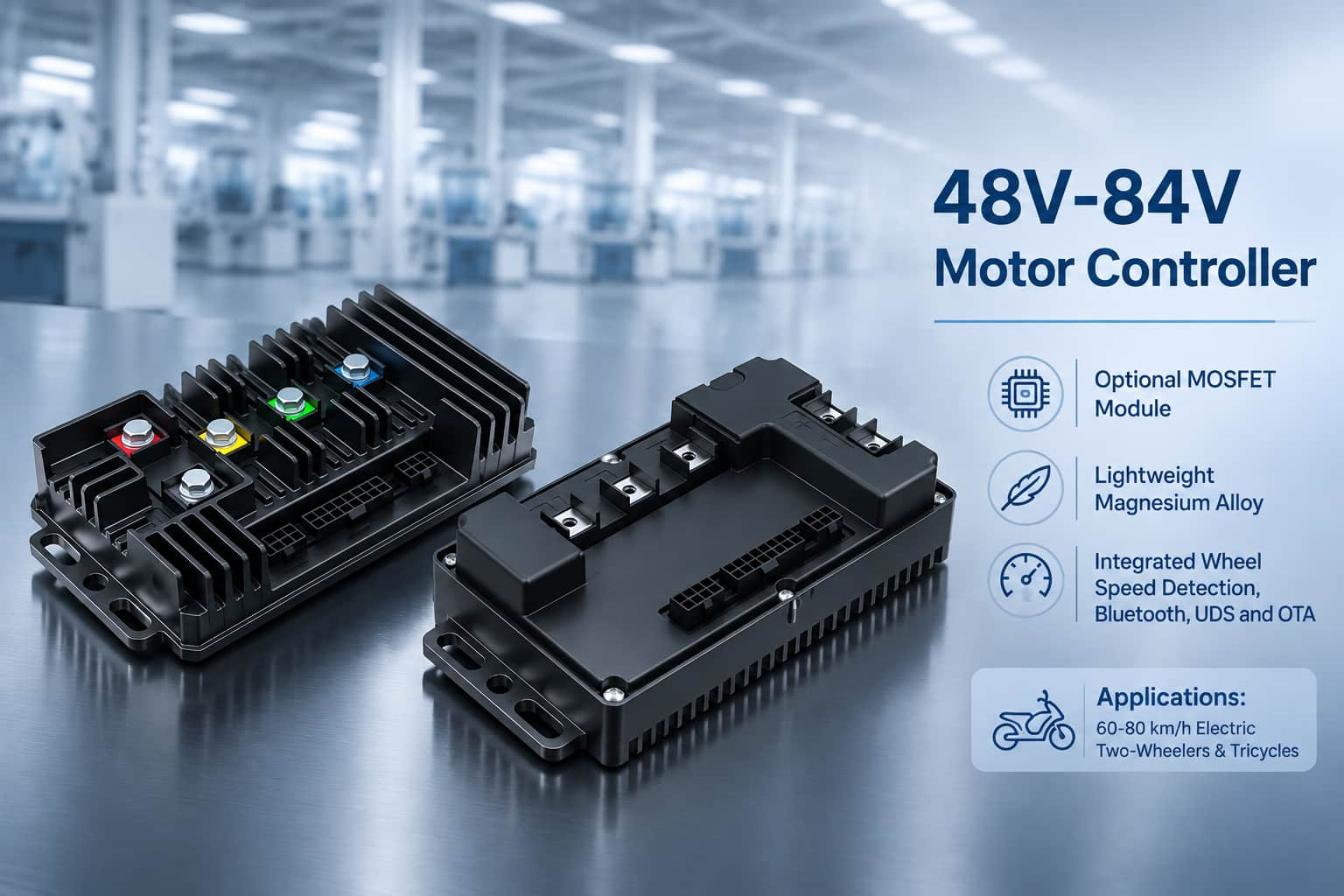
Our Lightweight Magnesium Alloy EV Motor Controller meets these advantages and is a practical upgrade solution. It can reduce the load weight of the entire vehicle while improving handling, without compromising the heat dissipation capacity. Our 48V–84V pure electric platform can achieve smooth and controllable power response and timely response during riding for two-wheeled and three-wheeled vehicles ranging from 60 to 80 miles.
Key Points For Manufacturers' Procurement And Selection And Common Misunderstandings
For OEMs and assembly manufacturers selecting an electronic control supplier, peak power parameters alone should not be the only consideration. They need to verify the continuous power specifications, temperature rise test reports under rated load, confirm compatibility with BMS and instruments, and verify the adaptability of the firmware to different motor models. In the early stage of electronic control selection, many purchasers tend to fall into the following Misconception:only pursuing peak current indicators. However, some electronic controls have high peak currents but insufficient cooling solutions, which can trigger power limits in real-load scenarios. Many customers also overlook communication stability and anti-interference design, which can cause signal abnormalities on bumpy roads.
A motor controller with OTA upgrade capability can bring long-term added value. It supports remote function optimization and fault diagnosis, which undoubtedly reduces a lot of pressure for the vehicle manufacturer in after-sales maintenance. High speed CAN technology controllers can solve the above pain points and achieve low-latency, stable data transmission between vehicle components, suitable for high-performance e-motor vehicles and heavy-load three-wheeled models.
WISE: Drive Solution For Electric Vehicle Manufacturers
As a motor controller supplier for two-wheelers, our 48V-84V motor controller product platform covers multiple rated voltages such as 48V, 60V, 72V, and 84V. The core parameters are as follows:
| Item | Product 1 | Product 2 |
| Rated Voltage | 48V / 60V / 72Vdc | 48V / 60V / 72V / 84Vdc |
| Operating Voltage Range | 35 – 85Vdc | 35 – 120Vdc |
| Rated Phase Current | 80A | 100A |
| Peak Phase Current | 260A | 300A |
| Bus Current | 80A | 100A |
| Compatible Sensor | Hall Sensor, Magnetic Encoder |
Hall Sensor, Magnetic Encoder (5V – 12V power supply for encoder) |
| Communication Method | One-line Communication, CAN2.0 | One-line Communication, CAN2.0 |
| Cooling Method | Natural Air Cooling |
Natural Air Cooling (Install on the windward side of the vehicle) |
| Hardware Options | Optional MOSFET module, lightweight magnesium alloy housing | |
| Built-in Functions | Wheel speed detection, Bluetooth, UDS, OTA | |
WISE provides professional electric drive power systems and driving solutions for electric vehicle manufacturers. Besides offering mature and standardized electronic control products, we also support customized development. Our R&D team can undertake the entire process of parameter calibration and power system matching services. Whether it is an electric two-wheeler or a cargo three-wheeler, we can complete the exclusive power tuning based on your vehicle model positioning and actual working conditions, to match the riding experience that customers need.
Contact Us
If you are looking to purchase a drive system for your electric two-wheel or three-wheel vehicle, or if you have a new project that requires upgrading the existing drive system, please feel free to contact us to obtain the specification sheet, request samples, and receive one-on-one technical consultation. We will match and calibrate the appropriate 48V drive control solutions for two-wheelers based on the target application scenarios and market positioning of your vehicle.